Women and Hair Loss
This blog will discuss two of the most common causes of hair loss in women and how to benefit them easily at home. In both cases, unlike male hair loss, for women the symptoms are a general thinning of hair across the whole scalp rather than receding lines.
Women's hair loss caused by auto immune diseases is much rarer and will be discussed separately in future. The first is telogen effluvium, in which there is a diffuse or widely spread out shedding of hairs around the scalp and elsewhere on the body. This is usually a reaction to intense stress on the body's physical or hormonal systems, or as a reaction to medication.
The condition, which can occur at any age, generally begins fairly suddenly and can either get better on its own or become a chronic problem. Telogen is actually a natural process and at any one time, up to about 15 per cent of hairs are in telogen. But a sudden stress on the body can trigger large numbers of hairs to enter the telogen phase at the same time. Then, about three months later, this large number of hairs will be shed.
Many adults have had an episode of telogen effluvium at some point in their lives, reflecting episodes of illness or stress. The other common type of hair loss in women is androgenetic alopecia, which is related to hormone levels in the body. There's a large genetic predisposition, which may be inherited from the father or mother. Androgenetic alopecia may affect up to 50% of women over the age of 40.
Research shows that up to 13 per cent of women have some degree of this sort of hair loss before the menopause, and afterwards it becomes far more common, with one piece of research suggesting that over the age of 65 as many as 75 per cent of women are affected. If your thinning has arrived alongside the other changes of perimenopause and menopause, our guide to menopause, skin and hair covers what is happening and what helps, for hair and skin together.
The cause of hair loss in androgenetic alopecia is a chemical called dihydrotestosterone, or DHT, which is made from androgens (male hormones that all men and women produce) by the action of an enzyme called 5-alpha reductase. People with a lot of this enzyme make more DHT, which in excess can cause the hair follicles to make thinner and thinner hair, until eventually they pack up completely. Although neither of these conditions are serious medical conditions they can affect self-esteem and so have negative effects on our lives.
The principal treatments in modern scientific treatment are the use of the drug minoxidil, hair transplants or scalp reduction using devices inserted under the skin. The disadvantages of the above treatments are that once you start using the drug minoxidil you have to keep using it or the hair will fall out again. This is particularly unnecessary in cases of telogen where the hair loss may only be temporary. The other two methods are very invasive surgical options and are unlikely to be the solution for most people. Given these options it is easy to see the advantages in using natural treatments at home wherever possible. There are several easy ways to benefit these conditions at home. From a traditional medicine perspective the main treatment principle is to improve the quality of the blood and increase blood flow to the scalp.
A particularly good example of this is the sudden hair loss experienced by many women following the loss of blood during child birth. By increasing the quality of the blood results can usually be achieved very quickly.
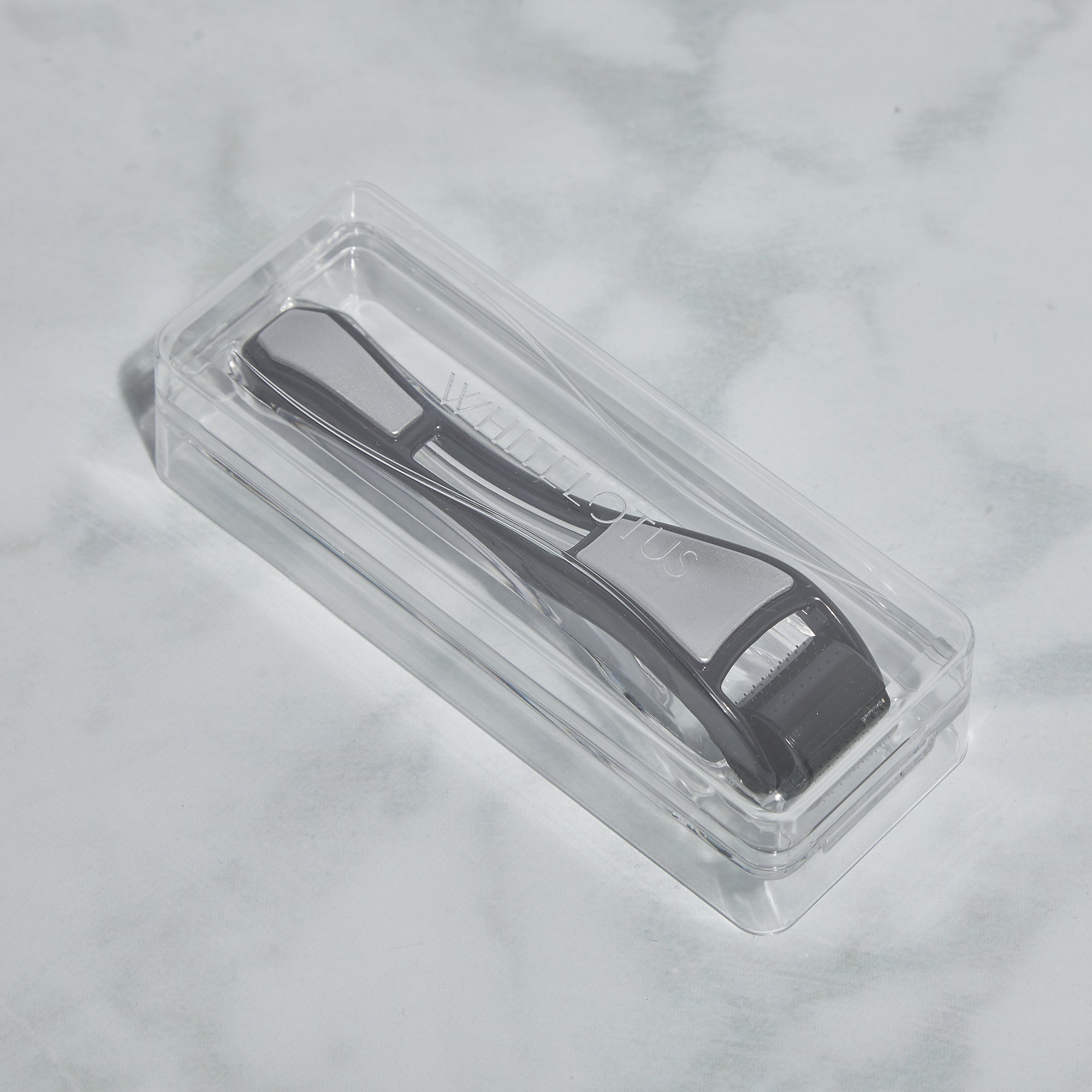
One of the easiest ways to do this is to use a derma roller or derma stamp on the scalp. The derma roller is a very simple way to dramatically increase blood flow to the scalp and also improve the quality of the scalp through its ability to stimulate collagen in the area. These products are simple and easy to use at home and more effective than simple head massage or inverted postures.
Which needle length. A 0.15mm roller is all you need for hair loss work at home. It is comfortable, it is safe to use regularly, and it does the two jobs that matter on the scalp: increasing blood flow to the area, and increasing the absorption of anything you apply afterwards.
If you would rather not use needles at all, our hair restoration without microneedling range covers the same ground with a crystal comb, scalp massage and topical herbs instead.
As a bonus the derma rollers can also increase the absorption of any women's hair loss products used on the scalp. Research into microfabricated microneedles has reported increases in skin permeability of up to four orders of magnitude, that is up to 10,000 times, compared with untreated skin.1 If using the derma roller with any lotions or tonics for the scalp make sure that the products are safe to use, as any listed side effects such as high blood pressure may be increased by the increased absorption.
We recommend using all natural products with the derma roller and only stock products made from traditional herbs in organic ethanol bases. We recommend you use products similar to this if you are planning to use them with the derma roller.
Other natural factors that can be used to assist female hair loss include:
- Eating a healthy diet, which is particularly important following child birth where the body has been quite debilitated.
- Reducing stress wherever possible.
- Doing mild exercise to increase circulation.
- Reducing the mechanical damage you do to the hair you still have. A silk lined cap, silk scrunchies from our silk collection, a silk pillowcase and a crystal comb all reduce the friction and snagging that breaks fine hair.
For the full range, see our hair restoration products.
Reference
1 Henry S, McAllister DV, Allen MG, Prausnitz MR. Microfabricated microneedles: a novel approach to transdermal drug delivery. Journal of Pharmaceutical Sciences, 1998. Institute for Bioengineering and Bioscience, School of Chemical Engineering, Georgia Institute of Technology, Atlanta, Georgia. Erratum in J Pharm Sci 1998 Sep;88(9):948.